Mastering the White 3d Text Effect for Modern Design
In the crowded landscape of digital and print media, grabbing attention is often a matter of milliseconds. Whether scrolling through a social feed or walking past a billboard, viewers are inundated with visual stimuli. This is where typography plays a pivotal role, not just in conveying information but in establishing an immediate visual hierarchy. Among the various typographic styles available to designers, the White 3d Text Effect stands out as a versatile and impactful choice. It offers a clean, modern aesthetic that bridges the gap between flat design trends and the need for depth and dimension.
This article explores the mechanics, applications, and practical value of using this specific text style. We will delve into why it works so well for both web interfaces and physical publications, how to leverage its editable nature for maximum efficiency, and what considerations designers should keep in mind when implementing it into their workflows.
The Visual Power of Dimensional Typography
Typography has evolved significantly over the last decade. While minimalism and flat design dominated the early 2010s, there has been a resurgence of interest in skeuomorphism and three-dimensional elements. However, unlike the heavy, realistic textures of the past, modern 3D text effects aim for a cleaner look. The White 3d Text Effect exemplifies this shift. By utilizing white as the primary color, the effect maintains high visibility and neutrality, allowing it to sit comfortably on top of vibrant backgrounds without clashing.
The "3D" aspect introduces depth, shadow, and perspective, which helps the text pop off the page or screen. This dimensional quality creates a tactile feel, suggesting substance and importance. For headlines, this is crucial. A flat headline might be read, but a dimensional one is felt. It signals to the viewer that the content beneath it is significant, urgent, or premium. The psychological impact of white space combined with depth is powerful; it suggests clarity, purity, and innovation—qualities highly sought after in branding and marketing.
Understanding the Editable Advantage
One of the most significant barriers for many creative professionals is the time required to create complex effects from scratch. Building a convincing 3D text effect involves manipulating layers, adjusting gradients, creating drop shadows, and refining bevels. This process can be tedious and requires a high level of technical proficiency in software like Adobe Illustrator.
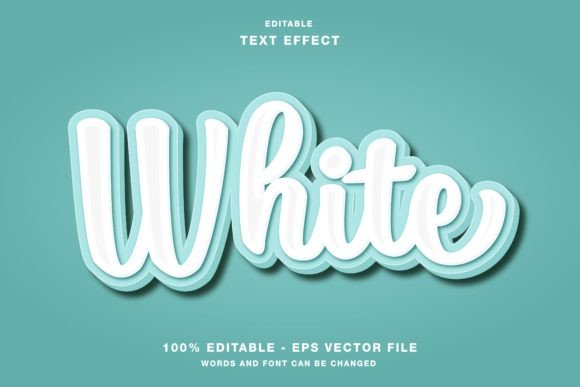
This is an Editable “White 3d Text Effect” for Illustrator designed specifically to solve this problem. The template is constructed to allow users to bypass the hours of manual construction. Because the file is built with vector paths and live text attributes, you can easily edit all elements. You are not stuck with a static image; you can change your text instantly while retaining the structural integrity of the 3D effect. This flexibility transforms a complex design task into a simple copy-and-paste operation, making professional-grade typography accessible to a wider range of creators.
Applications Across Digital and Print Media
The versatility of the White 3d Text Effect lies in its adaptability across different mediums. Whether you are designing for a small mobile screen or a large format poster, the principles of contrast and depth remain effective. Let's examine how this effect translates across various platforms.
Social Media Promotions
Social media platforms like Instagram, Twitter, and Facebook are visually driven ecosystems. Users scroll rapidly, and content must stop them in their tracks immediately. The White 3d Text Effect is particularly effective here because it provides strong contrast against colorful images or gradient backgrounds commonly used in social posts.
- Instagram Stories and Posts: Use the effect for bold headlines announcing sales, new product launches, or event dates. The white color ensures readability even over busy photos.
- Twitter Graphics: In a platform dominated by text, a graphic with 3D typography can break the monotony of standard tweets, increasing engagement rates.
- Facebook Ads: Attention-grabbing ad creatives are essential for conversion. A dimensional headline draws the eye before the user even reads the caption.
Web Design and UI Elements
On the web, usability is paramount. While decorative fonts have their place, they must never compromise legibility. The White 3d Text Effect strikes a balance. When used for hero section headlines, call-to-action buttons, or navigation elements, it adds a layer of sophistication without sacrificing clarity. Since the text effect color mode is RGB, it is optimized for screens, ensuring that the colors appear vibrant and true to life on monitors and mobile devices.
Print Publications and Events
Despite the digital boom, print remains a powerful medium for tangible marketing. Flyers, posters, magazines, and event papers benefit greatly from the perceived quality of 3D typography. When printed, the illusion of depth gives the material a premium feel. It suggests that the event or publication is high-end and professionally curated.
- Flyers and Posters: Large format prints allow the 3D details to shine. The white text stands out against dark or patterned paper stocks.
- Magazine Covers: Editorial design often relies on bold typography. This effect can make cover lines impossible to ignore.
- Event Paper: Invitations and programs gain a sense of occasion when the event title is rendered in a dimensional style.
Evaluating Suitability and Technical Considerations
While the White 3d Text Effect is a powerful tool, it is not a universal solution for every design challenge. Understanding its strengths and limitations is key to effective implementation.
Strengths and Value
The primary strength of this template is its customizability. Because it includes Eps and Jpg files in the main folder, you have options for both vector editing and raster usage. The EPS file allows for infinite scaling without loss of quality, which is critical for large print jobs. The JPG file offers quick compatibility for web use or presentation slides. Furthermore, the fact that it is fully editable means you can adjust the font size, weight, and even the angle of the 3D extrusion to match your specific brand guidelines.
Another significant advantage is the speed of production. In a fast-paced marketing environment, the ability to generate a high-quality headline in minutes rather than hours is invaluable. It allows designers to focus more on strategy and composition rather than getting bogged down in technical execution.
Considerations and Limitations
However, there are scenarios where caution is advised. First, consider the background. While white text offers great contrast on dark or saturated backgrounds, it may disappear on light or white backgrounds. Designers must ensure the underlying image or color palette supports the white foreground. If necessary, adding a subtle drop shadow or a background shape behind the text can enhance readability.
Second, accessibility is a growing concern in design. While 3D effects are visually appealing, they can sometimes reduce legibility for individuals with visual impairments. It is important to test the final design to ensure the text remains clear at various sizes and distances. Avoid using overly complex 3D angles that distort the letterforms beyond recognition.
Practical Expectations
When working with this template, users should expect a workflow that integrates seamlessly into Adobe Illustrator. The file structure is organized to make finding and editing elements intuitive. You can change the text content, modify the color of the 3D sides if needed (though the default white is often best), and export the result in the format required for your project. The RGB color mode ensures that digital outputs look crisp, but remember that for print, converting to CMYK might slightly alter the vibrancy of the white highlights, so always check a proof before final printing.
Real-World Scenarios: Putting the Effect to Work
To illustrate the practical application, imagine a local music festival planning their promotional campaign. They need assets for Instagram, a printed flyer for street distribution, and a banner for their website. Using the White 3d Text Effect, the designer can create a single master headline—"SUMMER BEATS 2024"—and apply it across all channels.
For the Instagram post, the text is placed over a photo of a sunset crowd. The white 3D letters stand out clearly, creating a focal point. For the flyer, the same text is scaled up and centered on a black background, looking sleek and modern. Finally, for the website, the text is used as the hero headline, drawing visitors in immediately. In each case, the consistency of the typography builds brand recognition, while the 3D effect adds a dynamic energy appropriate for a music event.
Similarly, a tech startup launching a new app could use this effect for their launch announcement. The clean, white aesthetic aligns with modern tech branding, suggesting simplicity and innovation. The editable nature allows them to quickly update the text for different press releases or social updates without losing the visual identity.
Conclusion
The White 3d Text Effect represents a convergence of aesthetic appeal and functional utility. It addresses the modern designer's need for speed without compromising on quality. By providing an editable, customizable template optimized for both RGB screens and print materials, it empowers creators to produce professional results efficiently.
Whether you are a business owner looking to elevate your marketing materials, a social media manager crafting engaging posts, or a graphic designer seeking to streamline your workflow, this tool offers substantial value. Its ability to work across diverse platforms—from Instagram to magazine covers—makes it a staple asset in any creative toolkit. As you evaluate your next design project, consider how adding a touch of dimension with white typography can transform your message from something merely seen to something truly experienced.